Productivity
Oct 20, 2025
Why Context Switching Is Killing 40% of Your Productivity (And What To Do About It) | Tetherly.ai
Why Context Switching Is Killing 40% of Your Productivity (And What To Do About It) | Tetherly.ai
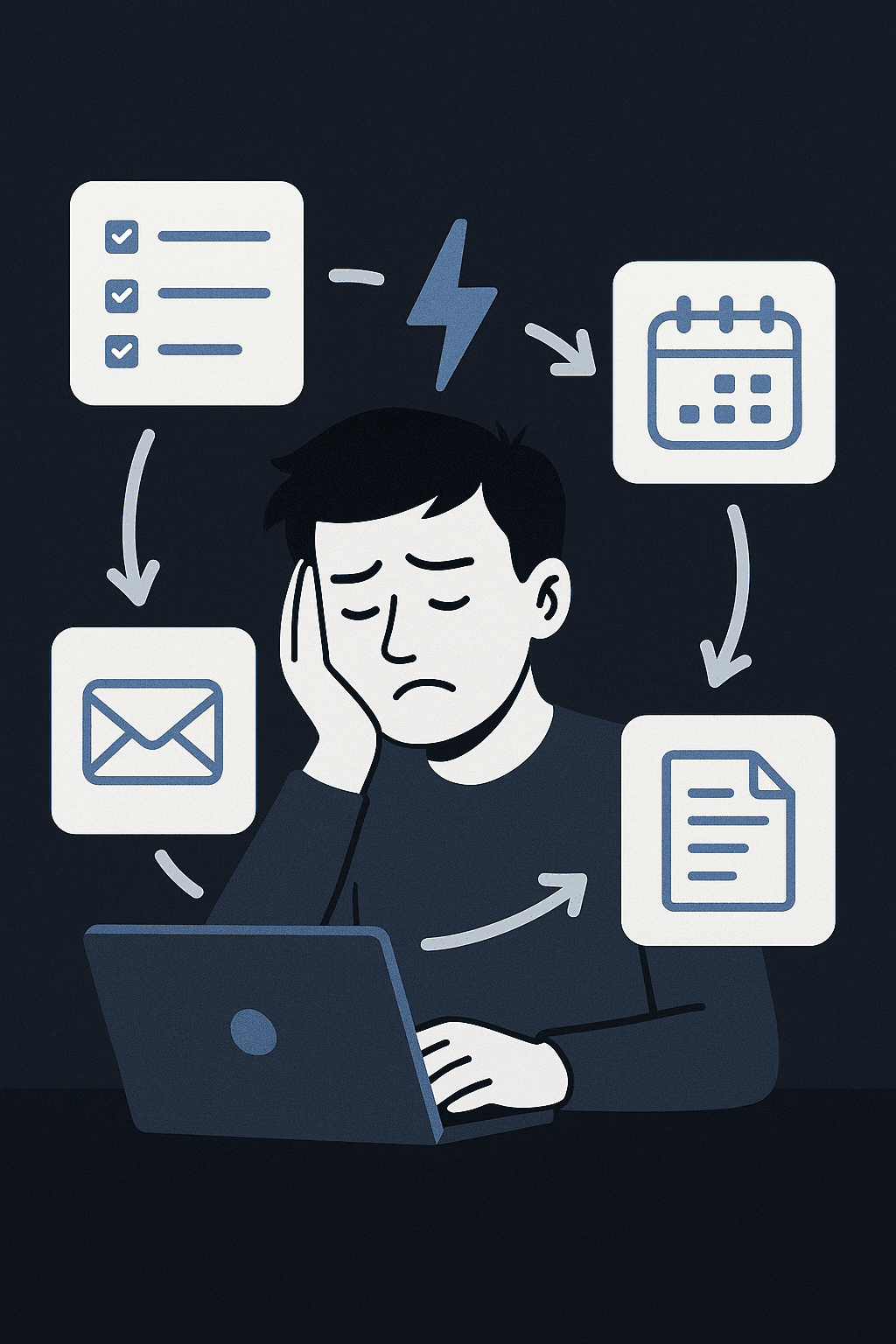
The Hidden Cost of Task Switching
Modern work is defined by speed — rapid responses, constant notifications, real-time collaboration.
But speed and productivity are not the same thing.
A 2024 Stanford Cognitive Efficiency Study found that employees who juggle multiple applications throughout the day lose up to 40% of their productive focus. This is not a marginal performance loss — it is the cognitive equivalent of pulling an all-nighter every week, simply to maintain pace.
Yet in most organizations, this state is considered normal.
Expected.
Sometimes even celebrated.
The cost of this norm is not merely burnout — it is systemic waste.
Work is being done, but much of it does not meaningfully contribute to progress.
The Science Behind the Burnout
Psychologists refer to context switching as micro-cognitive switching — the mental process of rapidly shifting attention from one task to another.
The American Psychological Association emphasizes that each switch forces the brain to pause, reorient, and rebuild context, consuming memory resources every time.
It is not the task that is exhausting.
It is the recovery cycle.
Research shows that after switching tasks:
It takes 15–23 minutes to regain full cognitive focus.
Working memory degrades temporarily.
Decision fatigue accumulates significantly faster.
Motivation decreases as perceived progress declines.
Teams believe they are collaborating more effectively when communication channels increase.
But what’s happening cognitively is the opposite:
Teams think they’re working faster — but they’re actually hemorrhaging focus.
The result is performance that looks busy but produces shallow output.
The Tool Landscape That Makes This Worse
In 2025, the average mid-market organization uses 130+ SaaS applications (Productiv, 2025 Workplace Systems Report).
Each tool promises efficiency.
But in aggregate, they create fragmentation.
Layer on:
Remote work
Distributed teams
Asynchronous communication
Real-time chat platforms
And organizations create environments where no single tool holds the full context of work.
Tasks live in:
Slack threads
Notion pages
Google Docs
Ticketing systems
CRM platforms
Unsaved meeting notes
Private messages
This fractures understanding.
Employees compensate through manual updates, cross-system checks, duplicate documentation, and status pings.
This is the hidden work of modern collaboration:
work about work.
And it scales linearly with headcount.
How Context Switching Reduces Organizational Performance
This hidden overhead accumulates into measurable operational drag:
Effect of Context Switching | Organizational Impact |
|---|---|
Delayed cognitive recovery | Slower task completion |
Fragmented knowledge retention | Reduced decision quality |
More messaging to regain context | Increased collaboration overload |
Higher fatigue and burnout | Increased turnover & disengagement |
Loss of deep work time | Lower innovation & strategic contribution |
This is not a productivity issue — it is a system architecture issue.
As long as systems remain disconnected, people are forced to act as the bridge between tools.
That bridge has a breaking point.
What “Seamless” Actually Means
Organizations often use the word seamless to describe workflows, but what most mean is “we switch between tools quickly.”
Speed is not seamlessness.
Seamlessness occurs when:
Tools share context
Updates propagate automatically
Data syncs without manual involvement
Work moves without humans coordinating it
This requires real-time integration, not just interface convenience.
The Role of AI-Driven No-Code Integrations
Modern AI-assisted automation can now:
Detect task intent (“This is a status update” → send to the right place automatically)
Extract meaning and context from conversations and documents
Sync data across systems continuously
Trigger workflow updates without requiring prompts
Summarize multi-thread discussions in structured formats
This is the difference between:
Using tools
andOperating in a connected workflow.
The ROI of Reducing Context Switching
When systems integrate and repetitive steps are automated:
Time is Reclaimed
Teams save 5–8 hours per week per employee (Asana Work Index, 2025).
That’s not efficiency — that is capacity.
Cognitive Load Decreases
Burnout risk drops by 23% because mental effort is spent on execution, not reconstruction.
Output Quality Improves
More hours in deep work produce better decisions, better analysis, better thinking.
Collaboration becomes alignment — not coordination
Teams stop asking “Where is this?” and start asking “What should we do next?”
This is how companies unlock compound productivity.
Productivity, Redefined
Real productivity is not:
More activity
More communication
More dashboards
More documentation
More responsiveness
Real productivity is:
Less friction
More focus
More continuity of thought
More time spent on meaningful work
This shift requires rethinking not the effort of work, but the architecture of work.
Where Tetherly.ai Fits In
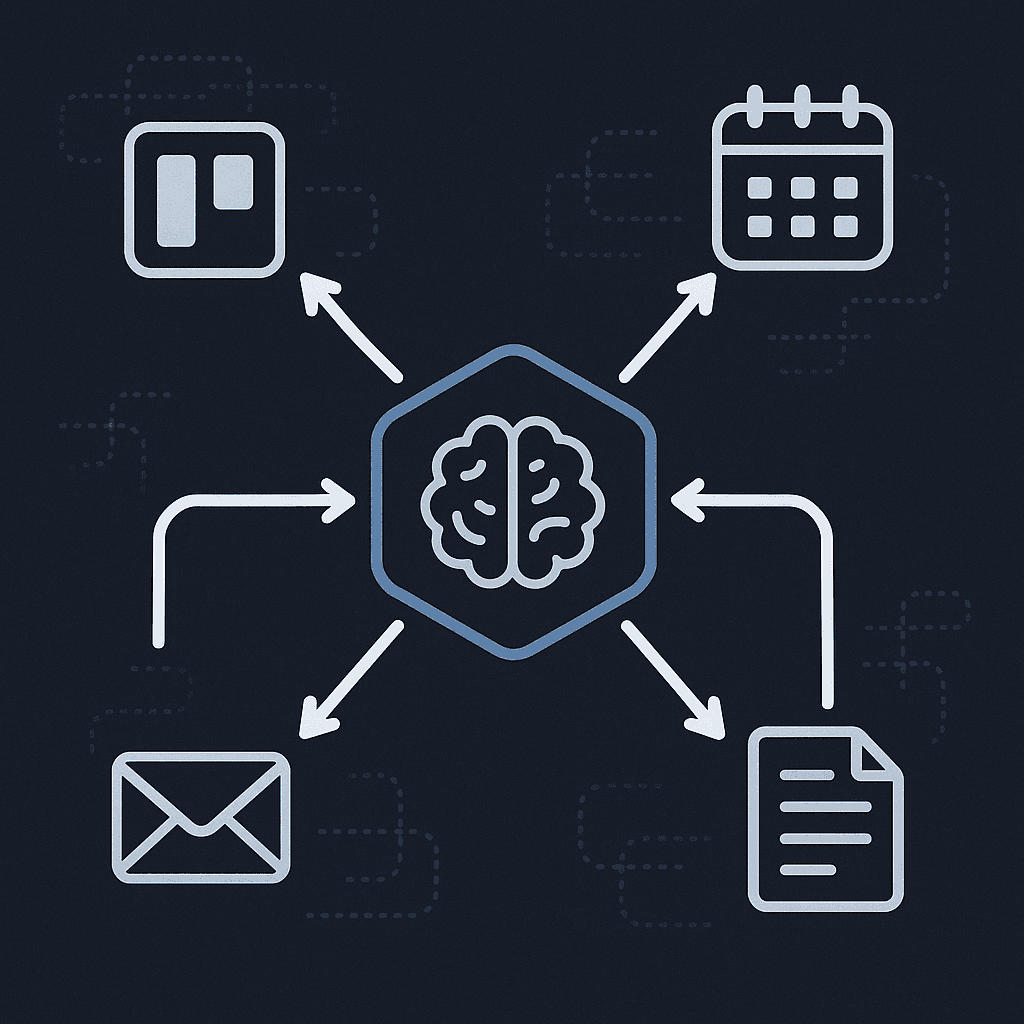
Most context switching exists because workflows are not truly connected.
Tetherly.ai removes this manual layer by:
Syncing tools in real time so updates never require re-entry
Preserving context, not just content, so meaning moves with information
Giving teams control over when and how workflows trigger
Automating repetitive operational steps so humans stay in deep work
Increasing ROI by reducing cognitive coordination overhead
Tetherly.ai doesn’t replace the tools teams already rely on.
It connects them into a system where work flows instead of fragments.
This is not a productivity hack.
It is workflow architecture as competitive advantage.
The Bottom Line
Context switching is not a personal discipline problem.
It is an organizational systems problem.
The companies that address it reclaim:
Time
Focus
Energy
Innovation capacity
Strategic momentum
Those that ignore it will continue mistaking motion for progress.
The future of productivity is not doing more.
It’s removing what never needed to be done in the first place.