Industry
Oct 20, 2025
The Future of Workflows: How Agentic AI and Real-Time Integrations Will Transform Industries | Tetherly.ai
The Future of Workflows: How Agentic AI and Real-Time Integrations Will Transform Industries | Tetherly.ai
The Silent Shift Already Underway
For decades, workflows inside organizations have been built around linear processes: a task moves from person to person, system to system, department to department. Each step depends on the previous one being completed. These workflows were efficient when the pace of business was slower, markets moved in predictable cycles, and the number of tools teams used was limited.
Today, none of those conditions hold.
Organizations now operate inside digital ecosystems, not simple process chains. Work moves fluidly across messaging platforms, documentation systems, analytics tools, customer systems, operational dashboards, and increasingly, AI assistants. Yet most workflows are still held together by humans manually copying, moving, reformatting, and reconciling information between these systems.
This “human middleware” layer has enormous cost.
Research from Asana’s Anatomy of Work study estimates that 58% of knowledge workers’ time is spent coordinating work instead of doing it. Gartner notes that context switching can reduce cognitive efficiency by up to 40%. Teams are accelerating, but the work about work is accelerating faster.
A new workflow paradigm is emerging to address this gap — one centered on agentic AI and real-time integration.
From Workflows to Adaptive Work Systems
Traditional workflow models are built on predictable sequences.
But modern work does not move in straight lines. It loops, branches, accelerates, pauses, and forks across systems and collaborators.
In this environment, workflows must behave more like ecosystems:
They must absorb new information as it appears.
They must adapt when conditions change.
They must operate without waiting for human intervention.
This requires workflows that are not only automated — but adaptive.
What Is Agentic AI?

While most organizations are familiar with AI as a tool that responds to prompts, agentic AI goes further.
Agentic AI systems can:
Interpret context rather than just content
Decide when to act, not just how
Execute tasks autonomously
Monitor outcomes and adjust behavior over time
Rather than simply answering questions, agentic AI participates in workflows.
It becomes a decision-maker — not a passive utility.
This allows workflows to run:
Continuously
Without waiting on human approval for routine steps
In alignment with organizational rules and context
In other words, agentic AI reduces the cognitive burden required to keep work moving.
Real-Time Integration: The Infrastructure That Makes Agentic AI Useful
Agentic AI is powerful only if it has full visibility into the work ecosystem.
This is where real-time integration becomes essential.
Real-time integration ensures:
Every system reflects the latest state of work
Information flows instantly
Decision logic is always based on current data
Actions propagate across tools without delay or duplication
Without real-time integration, even the most capable AI becomes:
Blind to context
Forced to rely on outdated data
Dependent on manual triggers
Real-time integration is not an enhancement — it is the foundation that lets AI act effectively inside organizations.
Industries Already Making the Shift
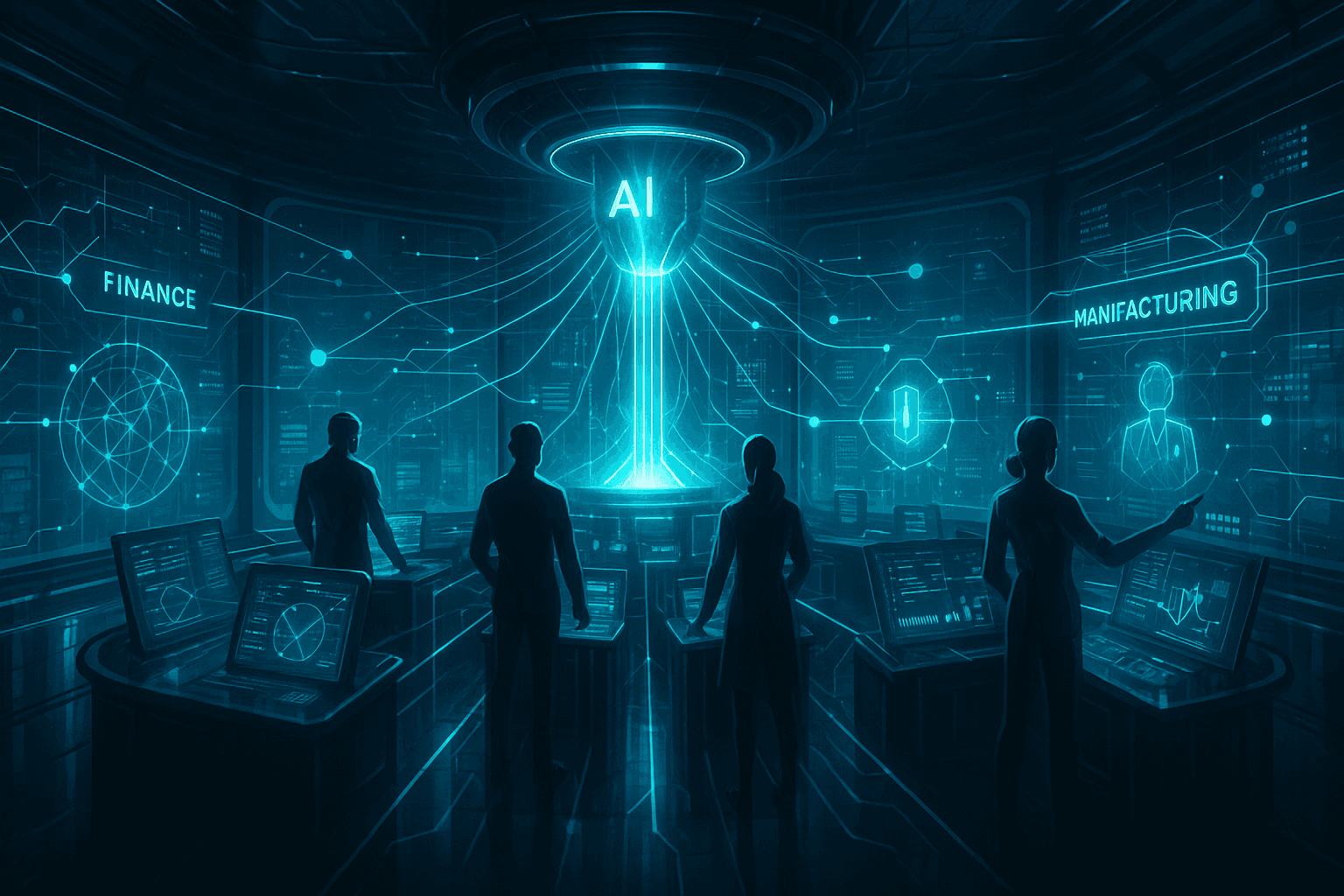
This shift is not speculative. High-velocity industries have already begun restructuring workflows around agentic AI + real-time synchronization.
Industry | Workflow Evolution | Operational Result |
|---|---|---|
Finance | Real-time anomaly detection and autonomous transaction policy enforcement | Higher audit accuracy, fewer delays, reduced human oversight load |
Healthcare | Instant patient record synchronization across EMRs, care teams, and billing | Reduced administrative overhead, fewer clinical errors |
Manufacturing | Self-optimizing production lines adjusting based on sensor inputs | Reduced downtime, increased throughput, faster quality correction |
Across these domains, the same pattern emerges:
Less manual coordination
Faster cycle time
More resilient operations
The competitive advantage no longer comes from working harder, but from removing friction from how work moves.
The Human Advantage
A common misconception is that automation displaces talent.
What we see in practice is the opposite.
Agentic AI does not replace human expertise.
It removes the friction that blocks expertise from being applied.
What disappears:
Status-check pings
Manual record updates
Copy-paste workflows
Meetings to “align” what could have synced automatically
What becomes possible:
Higher-quality strategic thinking
Faster decision-making
More experimentation and innovation
Work that compounds rather than stalls
The future is not fewer humans.
It is humans without busywork.
Tomorrow’s Workflows Will Be Orchestrated, Not Managed
The organizations that will lead the next decade are those that treat automation as infrastructure, not an accessory.
This means:
Workflows that update themselves
Information that synchronizes everywhere, instantly
AI that enriches context instead of requiring it
Teams that move in shared awareness, not fragmented views
Work will not be handed off — it will flow.
Systems will not be queried — they will inform.
Teams will not adapt to workflows — workflows will adapt to teams.
Where Tetherly.ai Fits In
Tetherly.ai is built on this exact principle.
Not “integrations” as in “a bridge between tools.”
But real-time, AI-driven workflow orchestration across the tools teams already use.
Tetherly.ai:
Connects systems so updates move instantly
Uses AI to reduce manual steps and context loss
Preserves meaning across tools (not just data)
Frees teams from coordination overhead
Turns workflows into living, adaptive systems
It is automation as infrastructure, not a feature.
It is workflow as ecosystem, not a sequence.
It is work that moves on its own, not work that waits.
The Shift Is Not Optional
Organizations will either:
Shift to adaptive, agentic workflows
orBe constrained by the coordination cost they can no longer afford
The companies that win will be the ones that design for flow, not control.
Agentic AI + Real-Time Integration is not a trend.
It is the operating model of modern work.
And the transition has already begun.