Productivity
Oct 19, 2025
How Modern Teams Are Unlocking Hours with AI-Powered No-Code Automation | Tetherly.ai
How Modern Teams Are Unlocking Hours with AI-Powered No-Code Automation | Tetherly.ai
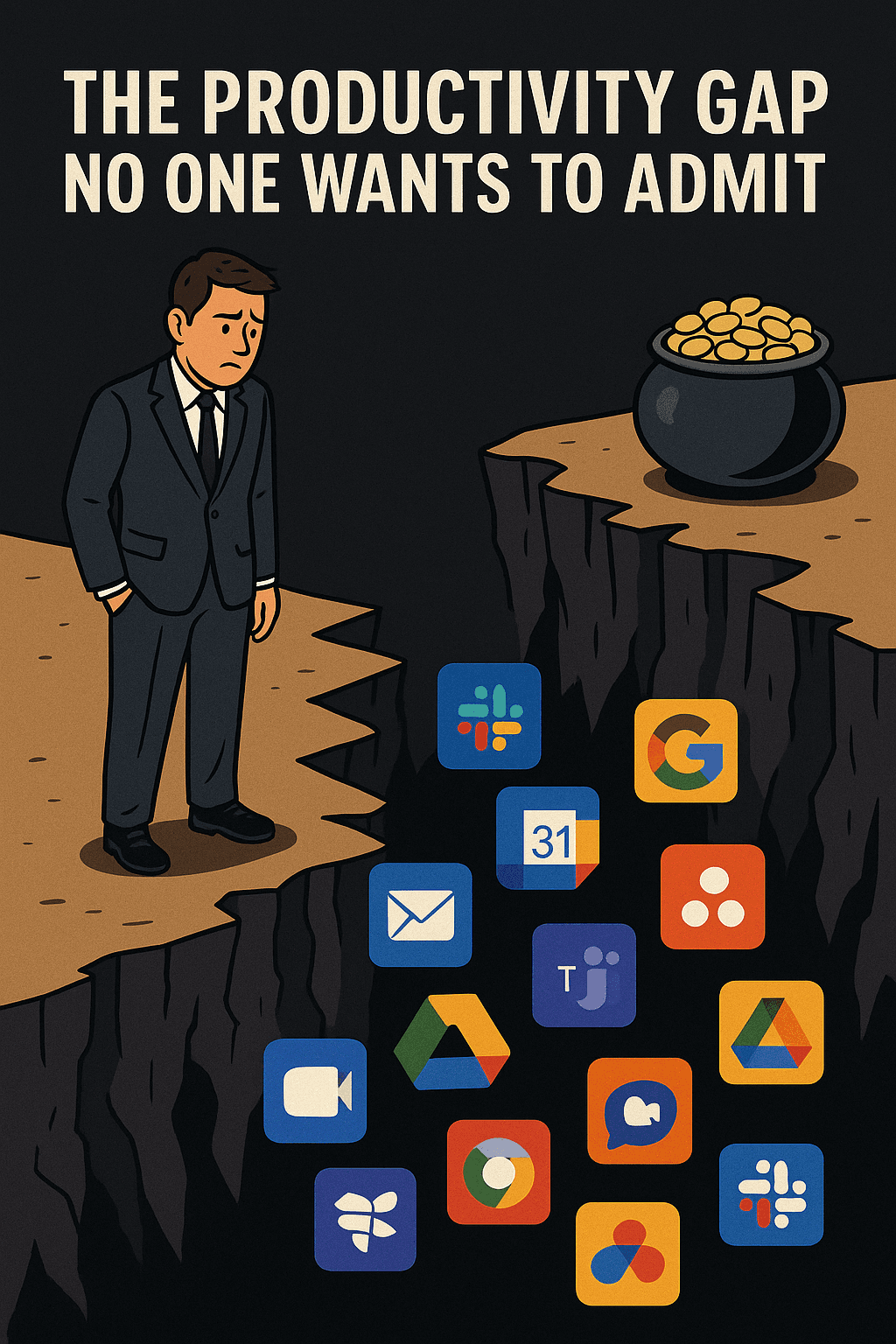
The Productivity Gap No One Wants to Admit
Across industries, teams are working harder than ever — yet few can confidently say they are working better.
According to Microsoft’s 2025 Work Trend Index, the average knowledge worker now spends 57% of their day “managing work” rather than actually doing work.
This includes messaging, updating trackers, searching for information, switching between SaaS tools, organizing task lists, and following up for clarification.
That equates to:
22+ hours per week
Every week
Per employee
Lost not to lack of capability — but to coordination overhead.
This is not a story of laziness, motivation, or even culture.
It is a workflow design failure.
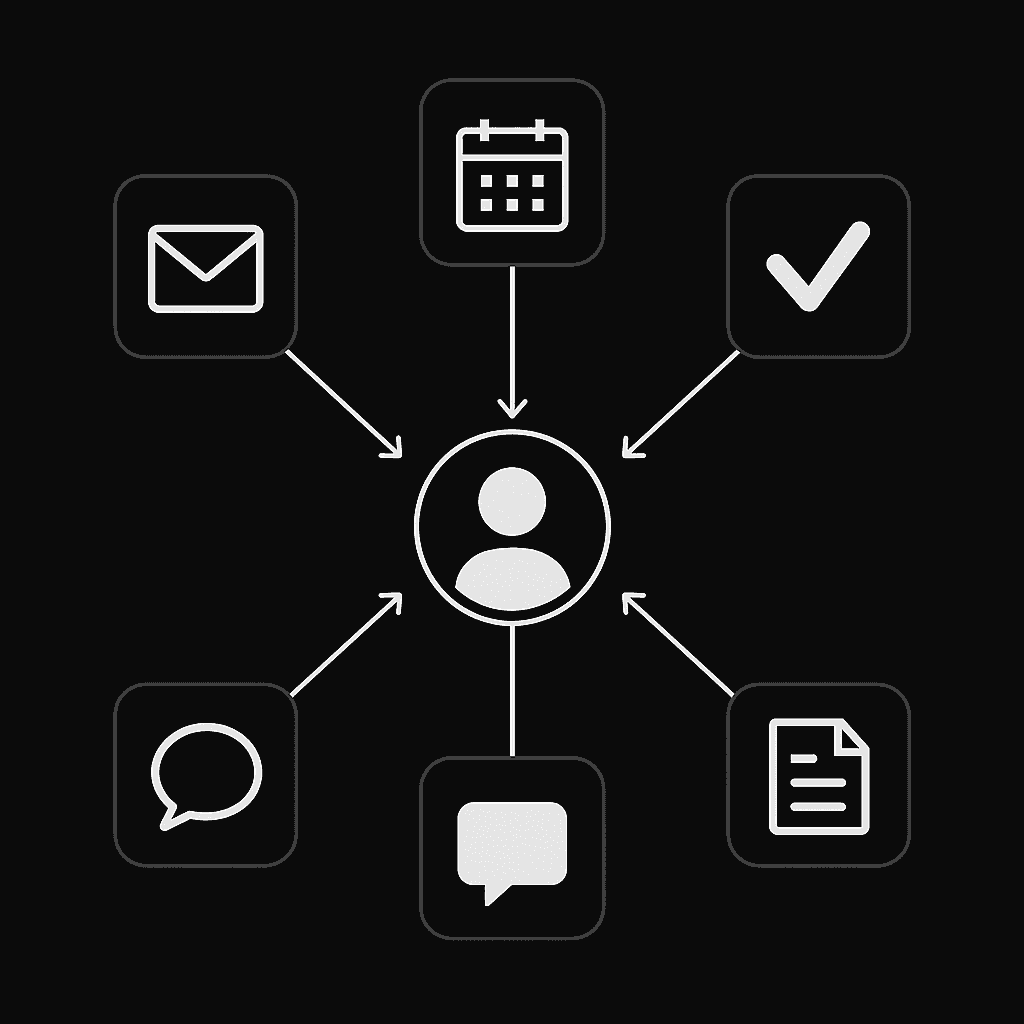
We are not drowning because work is hard.
We are drowning because work is fragmented.
Why We’re Drowning in Digital Busywork
Over the last decade, organizations accumulated productivity software at extraordinary speed.
The average mid-size company now uses 130+ SaaS applications (Productiv SaaS Trends Report, 2024).
Every tool solves a micro-problem:
A tool to chat
A tool to document
A tool to track tasks
A tool to store knowledge
A tool to collaborate
A tool to report
But few solve the workflow.
When systems don’t communicate:
Updates must be copied manually
Context must be re-explained
Information must be searched, often multiple times
Ownership must be re-established repeatedly
The American Psychological Association has shown that this context switching degrades working memory and reduces cognitive performance by 20–40%.
Not because the work is difficult — but because the brain must constantly reload the task environment.
We built tools to enable productivity.
But we built so many that we accidentally engineered friction into the workflow.
When tools don’t talk to each other, people become the integration layer.
This is where burnout begins.
What Breaks When Workflows Are Fragmented
The cost of fragmentation is not only measured in time lost.
It shows up across operational systems:
Consequence | Organizational Impact |
|---|---|
Constant task switching | Slower execution and decision-making |
Lost context between systems | Lower quality outcomes |
Manual data movement | Higher error rates |
Over-communication required to clarify | Increased cognitive fatigue |
Continuous coordination overhead | Reduced deep work capacity |
Work “feels urgent,” but progress feels slow | Team morale declines |
This dynamic creates a deceptive productivity environment:
Everyone feels busy.
Everyone is working.
Yet measurable progress is slower than expected.
In other words:
Teams are productive in motion, but not in outcome.
And motion alone does not create value.
The Rise of AI-Powered No-Code Automation
The new generation of automation platforms is different from the workflow automation of the 2010s.
Earlier systems relied on:
Scripts
Webhooks
API chaining
Rigid logic trees
They worked — but only if engineering resources were available.
Today’s automation layer is:
No-code
AI-assisted
Self-adapting
This shifts automation from a technical capability to a team-level operational practice.
What Makes This Shift Structural
Old Automation | AI-Powered No-Code Automation |
|---|---|
Requires engineers | Usable by operations & business teams |
Works only when workflows are stable | Adapts when workflows evolve |
Moves data without understanding it | Understands intent and context |
Hard to scale across teams | Scales instantly across the organization |
AI-powered no-code automation does three transformational things:
Works out of the box
No setup. No backend architecture. No project planning cycle.Understands context
AI interprets meaning, not just objects:
“Send this idea to documentation.”
“Turn this conversation into a task.”
“Store this as meeting context.”
Scales continuously
Once connected, workflows do not need to be rebuilt team by team — they cross-apply across the entire organization.
This is where the workflow stops being a chain of actions and becomes a living system.
The ROI: Real Hours, Not Abstract Efficiency
Automation is often framed as “efficiency.”
But knowledge-based work requires a different metric: Return on Time (ROT).
Recent productivity research shows:
Teams using AI-powered no-code automations save 6.8 hours per employee per week (Zapier Automation Report, 2024).
74% of managers report higher output with the same headcount (Asana Anatomy of Work Index, 2025).
Project cycle times accelerate 2–3x when repetitive workflows are automated.
Let’s quantify this strategically:
A 50-person team saving just 5 hours per week:
5 hours × 50 employees = 250 hours weekly
250 × 52 ≈ 13,000 hours yearly
Equivalent to:
6 full-time employees
Without hiring
Without managerial overhead
Without payroll expansion
This is not theoretical.
This is operational leverage made visible.
The Mental ROI: Clarity, Creativity, and Momentum
Time reclaimed is only part of the story.
The more consequential benefit is cognitive release.
Research from Stanford’s Cognitive Neuroscience Lab (2024) shows:
After 3 hours of task switching, creative reasoning ability drops by 23%.
After 6 hours, strategic decision quality decreases measurably.
This is not burnout from effort.
This is burnout from interruption.
When AI handles routine work:
The brain remains in flow state longer
Teams think more deeply
Strategy and problem solving improve
Work feels lighter, not heavier
Momentum returns — and momentum compounds.
The New Definition of Productivity
For the past decade, productivity was defined as:
“How much can one person get done?”
That definition belongs to the industrial era.
The emerging definition is:
“How much of a person’s time is spent on work that actually matters?”
The shift is from:
Activity → Intent
Output → Progress
Hours → Impact
AI-powered no-code automation is not a convenience.
It is a structural correction to 10 years of digital overload.
The companies that adopt it now will move faster, think clearer, and scale smarter — not by working more, but by working less on the wrong things.
The rarest competitive advantage of the next decade will be:
Return on Time.
Where Tetherly.ai Fits In
Most workflow inefficiencies don’t come from the tools themselves — but from the spaces between the tools.
Tetherly.ai is built for this exact intersection.
Tetherly.ai:
Connects communication and documentation systems in real time
Removes manual transfer work
Preserves context across tools
Automates the repetitive layer of workflows
Enables teams to operate in flow, not friction
It does not replace the tools teams already rely on.
It turns them into a unified workflow ecosystem.
This is how time becomes leverage.
And leverage becomes momentum.
The Bottom Line
We do not need more tools.
We need connected systems.
We do not need more activity.
We need space to think.
We do not need to work harder.
We need to work truer.
Productivity is no longer about doing more.
It’s about removing what never needed to be done at all.