Industry
Oct 20, 2025
From Proof of Concept to Production: How 5% of Companies Are Actually Getting AI Right | Tetherly.ai
From Proof of Concept to Production: How 5% of Companies Are Actually Getting AI Right | Tetherly.ai
The 5% Reality
Over the past five years, AI investment has surged across industries. Nearly every organization now has an AI strategy deck, an internal task force, or a set of pilot programs designed to “explore the potential” of artificial intelligence.
Yet the gap between experimentation and execution remains enormous.
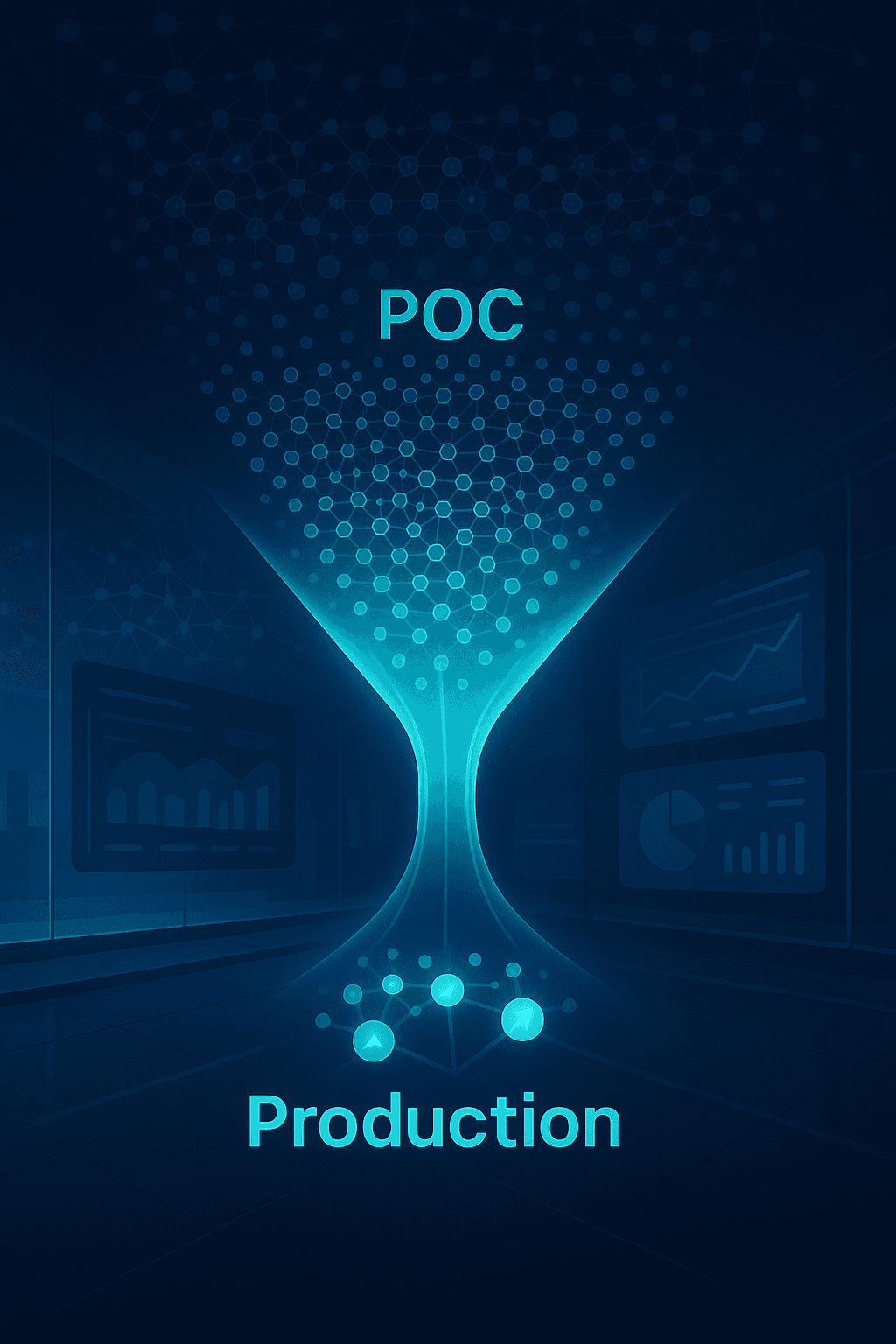
According to McKinsey’s 2025 State of AI Adoption, only 5% of companies successfully operationalize AI at scale.
The remaining 95% stall in pilot mode — running proofs of concept that produce presentations, not performance.
The challenge is not lack of interest.
It is lack of translation: turning AI from an exciting demonstration into a dependable part of daily work.
The result is a landscape of organizations who believe they are adopting AI — while their operations remain fundamentally unchanged.
The companies that break out of this cycle share consistent characteristics.
They treat AI not as an innovation exercise, but as workflow infrastructure.
Why Most AI Initiatives Fail
The gap between intention and outcome can be traced to four recurring organizational issues:
1. Fragmented and Unconnected Data
AI systems are only as strong as the data they are trained on.
Most organizations have information scattered across:
Chat applications
Knowledge bases
CRMs
Analytics suites
Cloud storage
Email threads
When data is siloed, AI becomes brittle — producing outputs that lack context, continuity, or consistency.
AI cannot create clarity in an environment defined by fragmentation.
2. Over-reliance on Consultants
Many AI pilots are designed and delivered externally.
While this helps organizations start faster, it creates two strategic liabilities:
Knowledge does not transfer
Internal teams cannot maintain or evolve the system
The result: companies can demo AI, but not operate it.
3. Poor Tool Integration
AI is often introduced on top of existing workflows instead of inside them.
This forces employees to switch tools to use AI — interrupting workflow, reducing adoption, increasing friction.
4. No Measurable ROI Framework
When AI adoption is justified as “strategic exploration,” success cannot be measured.
Without performance metrics, AI becomes a cost center — not a value generator.
Organizations hesitate.
Pilots stall.
Momentum collapses.
What the Successful 5% Do Differently
The companies that successfully move AI into production share a common approach:
They start small, integrate early, and scale workflows — not models.
They Focus on Utility, Not Capability
The question they optimize for is not:
“How advanced is the model?”
It is:
“Where does AI eliminate friction today?”
Small, visible wins accelerate organizational confidence and adoption.
They Connect Systems Early
Instead of treating integration as a final step, the top 5% identify key workflows where:
Communication
Documentation
Coordination
Decision-making
happen simultaneously.
Then they ensure these tools exchange data in real time.
AI without integration is theoretical.
AI with integration becomes operational.
They Design for Workflow Participation
AI that needs to be used breaks.
AI that participates in the workflow sustains.
This is the difference between:
Asking AI for summaries
vs.AI automatically summarizing relevant conversations when context matters.
The 5% do not insert AI into a workflow.
They rewire the workflow so AI is embedded from start to finish.
The Integration Imperative
AI only creates value when it has context and continuity.
And both require integration.
Without real-time integration, AI is forced to:
Work with stale data
Rely on incomplete context
Require manual prompting
Deliver inconsistent output
This pushes the cognitive load back onto the employee — defeating the purpose of automation itself.
When AI is integrated into communication and documentation workflows, something powerful happens:
Workflows run without human coordination
Context stays attached to decisions
Data remains synchronized
Processes become continuous, not episodic
The companies getting AI right aren’t building smarter tools.
They’re building connected systems.
Measuring the Real ROI
Organizations that successfully operationalize AI measure impact in practical terms, not abstract outcomes.
The strongest metrics include:
Metric | Why It Matters |
|---|---|
Hours Saved per Workflow | Measures reclaimed operational capacity |
Reduction in Manual Updates | Indicates automation quality & adoption |
Cycle Time Decrease | Shows acceleration of execution loops |
Error Rate Reduction | Demonstrates data integrity improvement |
Employee Experience / Burnout Scores | Tracks cognitive load reduction |
AI ROI is no longer defined by model performance.
It is defined by workflow transformation.
The Road Ahead
The next stage of AI adoption will not be determined by model sophistication, but by workflow orchestration.
Work will move through systems the way energy moves through a grid — continuously, adaptively, contextually.
AI will not be something employees “use.”
It will be something that runs alongside them, shaping work as it happens.
The organizations that succeed will:
Treat AI as infrastructure, not an experiment
Prioritize integration before automation
Focus on removing coordination friction
Measure operational, not conceptual, value
In 2025, value creation isn’t about whether a company has AI.
It’s about whether AI is connected.
Where Tetherly.ai Fits
Tetherly.ai is built on the same operating principle the top 5% already understand:
AI creates leverage only when workflows are connected.
Tetherly.ai enables organizations to:
Sync communication and documentation tools in real time
Preserve context across platforms
Reduce manual coordination steps
Automate repetitive workflow loops
Turn fragmented activities into flowing systems of work
It is not a productivity tool.
It is workflow infrastructure.
The companies that integrate intelligently will scale faster than those that don’t.
The gap will widen — quickly.
The Shift Is Clear
The question is no longer:
“Should we adopt AI?”
The real question is:
“Will we build workflows where AI can actually operate?”
The organizations that answer yes are already separating from the rest.